Raw potato brief
Share variety, size distribution, incoming condition and storage history. Include sample results if available. These inputs help frame preparation and frying trials; they are not replaced by a machine capacity label.
POTATO CHIPS PROCESSING
Plan an integrated potato chips line around raw potato quality, slice format, target output, seasoning, utilities and packaging requirements.
PROCESS BEFORE MACHINES
Potato chips can require a different process according to raw potato condition, slice format, moisture target, heating source, seasoning method and package type.
That is why this page explains the selection logic without publishing unconfirmed capacity, energy or price figures.
FROM THE ANBANG PRODUCT CATALOG
Use the catalog overview to discuss the connected process. It does not define the rated capacity, footprint or exact equipment included in your quotation.
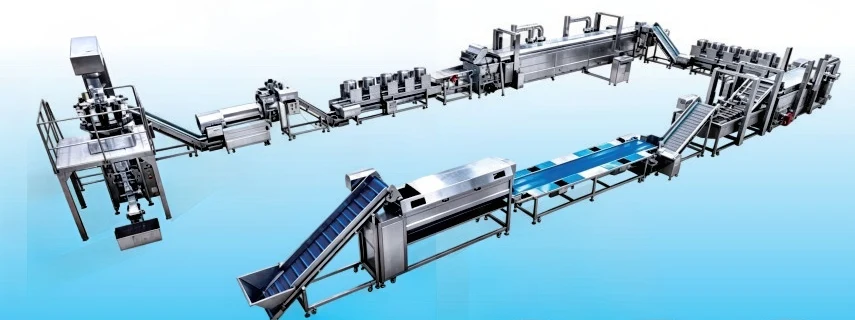
POTATO STRIPS & SLICES / CONFIGURABLE PROCESS
This original illustration appears in the French fries and potato chips section of the Anbang company catalog. It is a line overview, not a dimensioned layout or a customer installation photograph.
Before quotationConfirm slice style, saleable finished output, flavours, pack weight and seasoning or packing interfaces. This shared catalog illustration does not specify your final equipment layout.
Discuss this configurationDEFINE THE PRODUCT
This page concerns sliced, fried potato chips (potato crisps). Dough-based, formed or stackable products require a different process review.
Share variety, size distribution, incoming condition and storage history. Include sample results if available. These inputs help frame preparation and frying trials; they are not replaced by a machine capacity label.
Define flat or crinkle-cut slices, thickness, desired colour and texture. Send a reference product. Confirm tooling and the process route before treating different chip styles as interchangeable.
List flavours, changeovers, target grams per pack and packaging material. Identify whether seasoning and packing are new equipment or existing interfaces so the supply boundary stays clear.
TYPICAL PROCESS FLOW
The exact route is confirmed after the product and plant brief. Optional steps may be added, removed or adjusted.
CONFIGURATION LOGIC
Each module should support the steps before and after it. Selection is based on your confirmed product route rather than a generic machine list.
Washing, peeling and inspection modules are matched to the raw potato condition and cleaning target.
Slice format, rinsing, blanching and moisture removal are coordinated for stable downstream processing.
The fryer, filtration and oil circulation are selected around product requirements, heating method and target output.
De-oiling, seasoning, cooling and packing modules are arranged for the intended flavour and package format.
OUTPUT & PACKING
Ask for saleable finished output on an agreed basis, not an unexplained kg/h figure.
Raw potato input includes material that does not reach the finished bag. Peeling, trimming, moisture change, seasoning and rejected product affect the relationship. Do not use an assumed yield to convert raw input into a guaranteed packed output.
Nominal packed kg/h = packs/min × grams/pack × 60 ÷ 1,000. This is a unit conversion, not an Anbang equipment rating. Stops, rejects and changeovers reduce productive output. Check the sustained rate for each intended pack size.
A faster fryer alone does not establish system output. Agree the operating basis across preparation, frying, seasoning and packing. Request the layout, interface responsibilities and acceptance conditions alongside the equipment list.
Send conveyor heights, equipment drawings, demonstrated packer rates and stop/start signals. Leave access for operation, cleaning and maintenance in the layout review.
QUOTE-READY PROJECT
A useful quotation states what is included, what the factory supplies and what still needs technical confirmation.
Provide electrical voltage, phase and frequency, preferred heating source, available water and drainage, and compressed-air conditions. Confirm any packaging-gas requirement separately. Final utility loads follow the selected equipment.
Discuss flavour dosing, product feed, cleaning access and allergen-changeover requirements. Review cooling, transfer heights and gentle handling before the weigher; do not assume a generic conveyor layout suits fragile chips.
Request written inclusions for controls, installation, commissioning, training and spares. Agree trial material, pack format and acceptance checks before ordering; confirm delivery terms and schedule in the offer.
BEFORE MACHINE SELECTION
Share what you already know. If any field is not decided, Anbang can list the options that need confirmation.
CAPACITY & PRICE
Capacity and price cannot be determined accurately from the product name alone. Final configuration depends on raw material, finished product, target output, automation, heating method, oil management, seasoning and packaging scope, utilities, space and delivery requirements.
Anbang provides a project-specific recommendation after these inputs are reviewed.
BUYER QUESTIONS
This guide covers fried chips cut from whole potatoes, also called potato crisps. Formed or stackable chips start from a dough and need a different preparation and forming route. Send your intended product before assuming the same equipment applies.
Specify the slice shape, thickness and acceptable variation, preferably with a sample or photograph. Tooling and downstream handling must be reviewed for that specification; do not assume every slicer supports every format.
Pretreatment should follow the raw potato condition and finished-product target. Confirm whether blanching belongs in the agreed route through product and process evaluation, rather than applying one universal time or temperature.
No. Filtration addresses particles in the frying oil circuit; de-oiling acts on chips after frying. Ask which functions are included in the quotation. Neither equipment name alone establishes the finished oil content.
The quotation should identify the measurement point. Raw input, fried output and saleable packed output are different quantities. Agree the product, pack format, productive operating period and acceptance basis before comparing capacities.
Review gentle transfer, weighing, pack dimensions, film and sealing together. Do not select vacuum packaging simply because the product is food: assess crushing risk and the required pack presentation. Any gas-flushing option and shelf-life target need separate confirmation and validation.
Compare quotations with the same finished-output basis and supply boundary. Check preparation, frying and oil handling, seasoning, cooling, packing, utilities, controls and installation scope. A processing-only offer is not directly comparable with a complete packing project.
Provide the packer model, pack sizes, demonstrated operating rate, infeed height and control interfaces. Review transfer, buffering and stop/start coordination before confirming compatibility. Share flavour-changeover and cleaning requirements as well.
START WITH YOUR PROCESS
The prepared message asks for the details needed to discuss a practical configuration and quotation.